
TL;DR:
- Luxury branding creates emotional and social value, driving desirability and justifying premium prices.
- Quiet luxury and craftsmanship are gaining prominence over logo-driven branding.
- Emotional storytelling, exclusivity, and sensory experiences are key to maintaining brand power.
A logo is the least interesting thing about a luxury brand. The real power lies in what you feel when you hold a Bottega Veneta bag or slip on a pair of Prada loafers: a quiet certainty that you belong to something rare. Luxury branding operates on layers of emotion, craft, and social signaling that most consumers never consciously register, yet these invisible forces drive billions in purchasing decisions every year. This article breaks down exactly how branding shapes desirability, justifies premium pricing, and steers the biggest trends in high-end fashion today.
Table of Contents
- Why branding matters in luxury fashion
- Core strategies luxury brands use to maintain exclusivity
- How branding justifies premium pricing and shapes consumer choices
- Evolving luxury: Quiet branding vs. logo signaling
- A new era: Why luxury branding is about quiet confidence
- Experience luxury branding redefined
- Frequently asked questions
Key Takeaways
| Point | Details |
|---|---|
| Branding drives desire | Emotional and social cues in branding make luxury items symbols of identity and status. |
| Exclusivity through strategy | Luxury brands use unique tactics to maintain desirability—from brand extensions to multisensory methods. |
| Quiet luxury is ascendant | Understated design and craftsmanship now rival logos as signals of elite taste. |
| Premium pricing justified | Affluent buyers see higher prices as warranted by reputation, quality, and narrative. |
Why branding matters in luxury fashion
Luxury branding is a system of meaning. It tells a story about who made something, why it matters, and who you become when you own it. That story is far more valuable than any physical material, and the most successful fashion houses understand this completely.
“Branding in luxury fashion creates emotional connections, exclusivity, and status signaling for affluent consumers, transforming products into symbols of identity and belonging.”
When you invest in a piece from Gucci or Alexander McQueen, you are not simply purchasing fabric and hardware. You are buying access to a narrative, a community, and a set of values that reflect your own identity. This is why understanding luxury fashion requires looking beyond craftsmanship alone. The emotional architecture around a product is what sustains desire across decades.
Brand equity, specifically the combination of reputation, image, and perceived quality, plays a measurable role in purchase behavior. Brand equity aspects like reputation and image significantly influence purchase decisions among luxury consumers. This means that even before a customer touches the product, the brand’s accumulated prestige has already done most of the selling.
Affluent consumers are also acutely aware of social context. A well-branded piece communicates taste, discernment, and financial confidence without a single word. The luxury fashion reputation that houses like Balenciaga and Prada have built over generations is not accidental. It is the result of disciplined storytelling, selective distribution, and an obsessive attention to every brand touchpoint.
Here is why affluent consumers consistently gravitate toward well-branded fashion:
- Emotional resonance: Strong branding creates a personal connection that outlasts any single trend.
- Social signaling: Recognized brands communicate status and belonging within specific circles.
- Quality assurance: A trusted brand name reduces the perceived risk of a high-stakes purchase.
- Identity expression: Luxury pieces allow consumers to project their values and aspirations outward.
- Investment logic: Well-branded items hold or appreciate in value, adding financial justification to emotional desire.
Each of these factors compounds over time. The longer a brand maintains its narrative integrity, the more powerful its pull becomes.
Core strategies luxury brands use to maintain exclusivity
Knowing why branding matters is one thing. Understanding how the world’s best fashion houses actually build and protect that brand power is where the real insight lives.
Key methodologies used by modern luxury brands include brand extensions, ingredient branding, omnichannel marketing, multisensory experiences, and co-branding to maintain exclusivity while expanding reach. These are not random tactics. They are a coordinated system designed to keep a brand feeling both accessible and aspirational at the same time.
Five essential tactics modern luxury brands rely on:
- Controlled brand extensions: Introducing new product lines (fragrances, eyewear, home goods) that carry the brand’s prestige without diluting the core.
- Ingredient branding: Highlighting proprietary materials or techniques, such as Loro Piana’s vicuña fiber, to reinforce quality credentials.
- Omnichannel consistency: Delivering the same elevated experience whether a customer shops in a Milan flagship or on a mobile device.
- Multisensory environments: Using scent, sound, lighting, and texture in retail spaces to create emotional imprinting.
- Strategic co-branding: Collaborating with artists, architects, or other luxury houses to spark cultural relevance and attract new audiences.
The data supports continued investment in these approaches. 66.9% of executives expect stable or growing revenues in 2026, with pricing power and brand desirability listed as top priorities. This confidence is not blind optimism. It reflects how deeply these branding strategies insulate luxury houses from economic volatility.
| Executive priority | % citing as key focus |
|---|---|
| Pricing power | High |
| Brand desirability | High |
| Revenue growth outlook (stable/growing) | 66.9% |
| Digital channel investment | Growing |
Pro Tip: If you are drawn to quiet luxury strategies, pay attention to how brands use multisensory cues in their digital spaces. The texture of a website, the pacing of a campaign video, and the tone of product descriptions all function as branding signals, even when there is no logo in sight.
How branding justifies premium pricing and shapes consumer choices
Premium pricing in luxury fashion is not arbitrary. It is a carefully calibrated signal, and branding is what makes consumers not just accept it, but actively seek it out.

Research confirms that premium pricing is perceived as justified when brand equity, reputation, and image are strong. Consumers are not paying for cost of production. They are paying for the story, the heritage, and the social currency that comes with the piece.
Luxury prices rose 61% between 2019 and 2025, yet demand among top-tier consumers remained resilient.
That statistic alone tells you something important: price sensitivity in the luxury segment behaves differently than in any other market. When a brand’s narrative is strong enough, price increases can actually reinforce desirability rather than suppress it.
What drives this willingness to pay? 51% of consumers cite quality as the key driver for high-end perception, while 47% point to brand story. This means that the narrative a brand builds around its heritage and values is nearly as important as the physical product itself.
Here is how branding elevates product value step by step:
- Scarcity signals: Limited production or waitlists create urgency and reinforce the sense that ownership is a privilege.
- Heritage narrative: A brand’s history, founding story, and iconic moments add layers of meaning that justify price.
- Visual identity: Consistent, recognizable aesthetics build familiarity and trust over time.
- Quality association: Branding anchors the perception of superior materials and craftsmanship, even before the product is examined.
- Social proof: When aspirational figures wear a brand, it validates the purchase decision for others.
| Brand type | Pricing level | Desirability signal | Consumer profile |
|---|---|---|---|
| Logo-heavy | High | Instant recognition | Status-driven buyers |
| Silent/quiet | Higher | Insider knowledge | Connoisseur buyers |
Understanding brand equity value helps explain why two bags of similar construction can differ by thousands of dollars in price. And if you want to understand how these dynamics affect luxury buying decisions at the retail level, the mechanics are surprisingly consistent across categories.
Evolving luxury: Quiet branding vs. logo signaling
The shift happening in luxury right now is one of the most interesting in decades. Logo-heavy branding, once the dominant language of status, is being challenged by a quieter, more nuanced form of self-expression.
Silent brands show higher prices despite slightly lower search interest, with logo-heavy brands averaging 51.1 on Google Trends versus 41.1 for silent brands between 2020 and 2025. Less visibility, higher price. That is a counterintuitive result that reveals something profound about where luxury is heading.
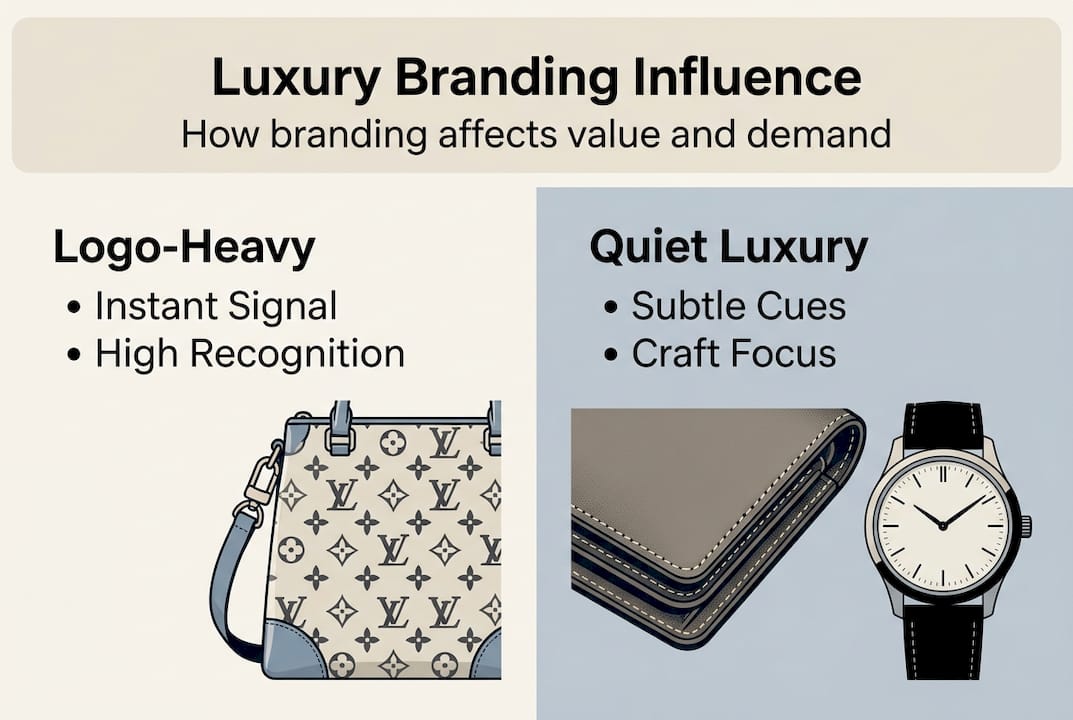
The reason is rooted in logo democratization. As luxury logos spread through fakes and resale markets, the signal they once carried becomes diluted. Connoisseurs respond by shifting toward craftsmanship, texture, and silhouette as their primary markers of taste. A Loro Piana cashmere coat or a The Row blazer communicates far more to the right audience than a monogram ever could.
For a deeper look at quiet luxury explained and how to build a wardrobe around it, the principles are consistent: invest in construction, prioritize fit, and let the material speak.
Pros and cons of each approach:
Quiet branding:
- Appeals to insiders and connoisseurs
- Commands higher prices in the true luxury tier
- More durable as a long-term style investment
- Requires greater knowledge to appreciate
Logo-driven branding:
- Delivers instant recognition and social impact
- Broader aspirational appeal
- More vulnerable to counterfeiting and trend cycles
- Can feel dated faster
Exploring minimalist luxury looks gives you a practical sense of how quiet branding translates into actual outfits. And understanding seasonal luxury shifts helps you track when brands pivot between these two poles in their collections.
Pro Tip: To spot a genuinely exclusive piece beyond the logo, examine the seam finishing, the weight of the hardware, and the consistency of pattern matching at joins. These details are where real luxury investment shows, and they are invisible to anyone who does not know what to look for.
A new era: Why luxury branding is about quiet confidence
Here is the perspective that most coverage misses: the most powerful luxury branding today is not about being seen. It is about how you feel when no one is watching.
Affluent consumers have largely moved past using fashion as mass validation. The goal is not to broadcast wealth to strangers. It is to wear something that confirms your own taste and judgment, something that communicates fluency in a language only a few people speak. Quiet luxury insights consistently point to this shift: the buyer is no longer performing for an audience. They are investing in a personal standard.
This changes what branding actually needs to deliver. Craftsmanship, storytelling, and perceived quality are now the real currency. A brand that can make you feel that its piece was made specifically for someone with your level of discernment has won the highest-value game in fashion. That is not a logo play. That is a narrative and sensory experience built over years. The brands that understand this are the ones quietly setting the prices everyone else aspires to.
Experience luxury branding redefined
The principles covered here, emotional resonance, exclusivity, craftsmanship, and narrative depth, are not just abstract concepts. They are exactly what separates a forgettable purchase from a piece you reach for again and again.
At Mara Formigone, we have curated a selection that reflects both sides of the luxury branding spectrum. From iconic logo pieces by Gucci, Prada, and Balenciaga to quietly powerful designs that speak through construction and material, every item in our curated luxury collections is chosen with the same discernment this article describes. If you are ready to experience luxury branding as it was meant to be felt, explore what we have assembled for you.
Frequently asked questions
How does branding create value in luxury fashion?
Branding transforms fashion items into symbols of exclusivity, emotional connection, and social identity, making them more desirable and valuable beyond their physical components.
Why do some luxury brands avoid logos?
Many top brands embrace subtle branding to appeal to connoisseurs and avoid dilution, since logo democratization via fakes and resale erodes the exclusivity that made the logo meaningful in the first place.
Is paying higher prices really justified by branding?
Research shows that brand equity aspects like reputation and image make premium pricing feel justified, because consumers are buying narrative, heritage, and social currency alongside the physical product.
What new trends are driving the role of branding in 2026?
Greater focus on multisensory and omnichannel experiences, combined with the continued rise of understated luxury, is reshaping how brands build deep connections with today’s most discerning buyers.
Recommended
- What is luxury fashion: Understanding high-end style in 2026 – MaraFormigone
- Influencer marketing drives 650% ROI in luxury fashion
- Why Designer Shoes Are Coveted: Status, Craft Revealed – MaraFormigone
- High-end fashion styling tips for luxury looks in 2026
- Why limited edition jackets make a style statement in 2026

