
TL;DR:
- Fashion trends follow roughly 20-year cycles driven by generational and cultural shifts.
- Digital media accelerates trend cycles from years to weeks, increasing the importance of strategic curation.
- Luxury emphasizes heritage, craftsmanship, and signature accessories over fleeting trends for lasting prestige.
Luxury fashion has a memory. Bell-bottoms resurface, minimalist silhouettes return, and the accessories your grandmother treasured are suddenly the most coveted items on the runway. This is not nostalgia for its own sake. Fashion trends evolve primarily because of a tension between wanting to belong and wanting to stand out, producing cyclical patterns roughly every 20 years. Understanding why trends shift gives you a real edge: you stop reacting to every seasonal change and start building a wardrobe with genuine staying power. Here is what is actually driving the evolution of luxury style.
Table of Contents
- The forces that drive fashion evolution
- Cyclical patterns and fragmentation in luxury trends
- How digital media accelerates trend cycles
- Luxury’s new focus: Prestige over mass trends
- A fresh perspective on following luxury trends
- Curate your luxury style with MaraFormigone
- Frequently asked questions
Key Takeaways
| Point | Details |
|---|---|
| Trend evolution explained | Fashion changes because of a push and pull between fitting in and standing out, shaped by society. |
| Cycles and diversity | Luxury trends have roughly 20-year cycles, but modern fragmentation means more unique options now. |
| Digital acceleration | Social media shrinks the time between new trends, making rapid style changes the new normal. |
| Luxury strategies | Brands now prioritize exclusivity and heritage, especially with iconic accessories, over mass trends. |
| Mindful curation | The smartest luxury consumers build collections based on personal style, not every fleeting trend. |
The forces that drive fashion evolution
Fashion does not change by accident. Every major shift in what we wear traces back to something bigger happening in the world around us. Cultural, social, technological, and economic shifts drive fashion evolution in a feedback loop, meaning fashion both reflects society and actively shapes it.
At the core of this loop is a simple human tension. We want to fit in with our peers, but we also want to express who we are as individuals. When one impulse dominates for too long, the other pushes back. A decade of maximalist excess often gives way to clean, restrained aesthetics. A period of rigid formality eventually breaks open into expressive, rule-breaking dressing.
Beyond individual psychology, broader cultural forces play a major role:
- Art and music movements shift the visual language of an entire era, pulling fashion in new directions
- Political climates influence whether fashion leans into power dressing or quiet rebellion
- Technological innovation changes what fabrics, silhouettes, and production methods are even possible
- Economic conditions determine who can access luxury and how brands position prestige
The economic dimension is particularly important for luxury consumers. The global fashion business growth from bespoke couture to mass ready-to-wear fundamentally changed who sets the agenda. When luxury was purely the domain of haute couture, a small group of designers dictated global taste. As production scaled and access widened, the number of competing aesthetics multiplied.
Understanding the luxury fashion definition matters here because luxury operates differently from mainstream fashion. It moves more deliberately, prioritizes craftsmanship over speed, and uses trend cycles as a tool rather than a treadmill.
Statistic: The global luxury fashion market continues to outpace general apparel growth, reinforcing that prestige positioning is more resilient than trend-chasing strategies.
The interplay of all these forces means fashion evolution is never truly random. It is patterned, even if the patterns are complex.
Cyclical patterns and fragmentation in luxury trends
If fashion trends feel like they keep coming back, that is because they do. Empirical data from 37,000+ clothing images spanning 1869 to the present confirms approximately 20-year cycles in measurable features like hemlines and silhouette width. The math is surprisingly precise.
The mechanism is generational. A style that defined your parents’ youth feels dated to you, but by the time you have children, it reads as fresh and nostalgic to them. Each generation reinterprets the past through a contemporary lens, which is why revivals rarely look exactly like the original. They are filtered through new materials, new cultural references, and new proportions.
Here is how the pre and post-1980 trend landscape compares:
| Feature | Pre-1980 trends | Post-1980 trends |
|---|---|---|
| Cycle length | Consistent ~20 years | Compressed and fragmented |
| Style diversity | Relatively unified | Highly varied, niche-driven |
| Who sets trends | Couture houses, editors | Influencers, subcultures, algorithms |
| Consumer role | Passive follower | Active co-creator |
| Trend lifespan | Seasons to years | Weeks to months |
After 1980, something shifted. The rise of global media, fast fashion, and eventually the internet broke the clean 20-year rhythm. Niche communities began generating their own aesthetics entirely outside the traditional fashion calendar. Streetwear, vintage culture, and subculture-driven dressing all flourished independently.
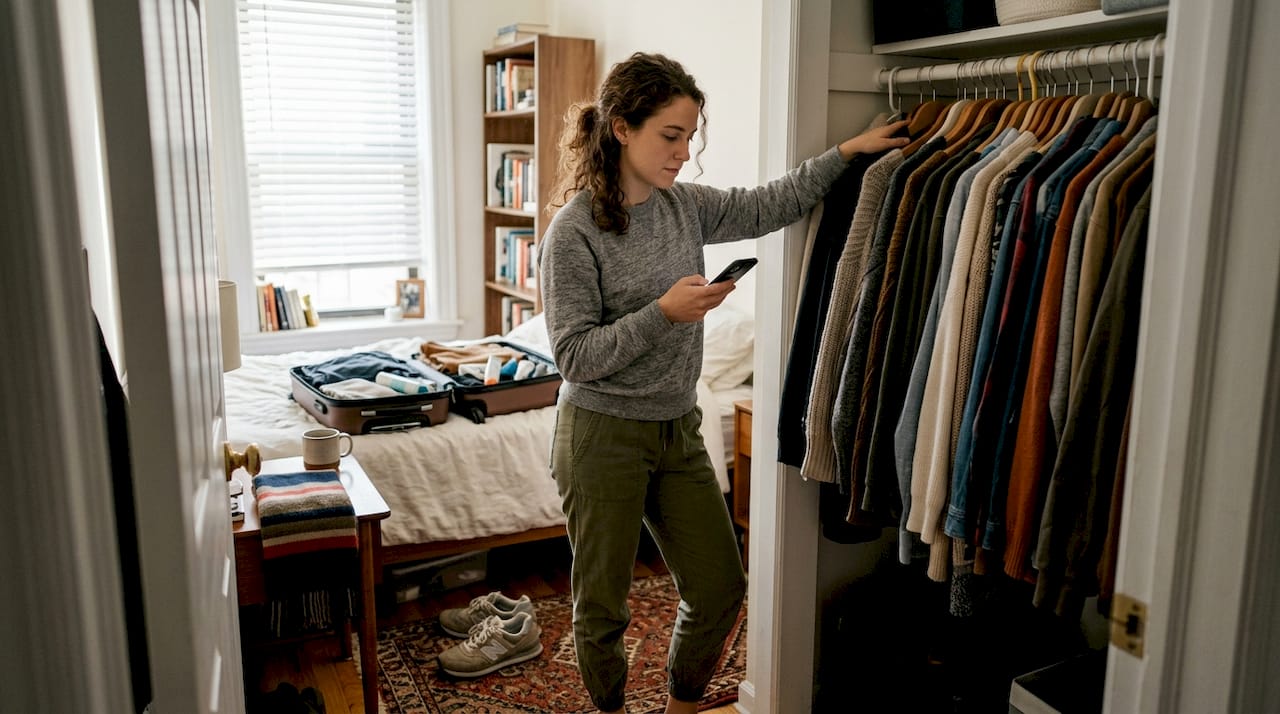
This fragmentation is not a problem for the informed luxury consumer. It is actually an opportunity. When you refresh your luxury wardrobe with an understanding of cyclical patterns, you can anticipate revivals rather than scramble to catch them. Knowing that luxury fashion seasons now overlap with micro-seasons and drops means you can be more selective about what you invest in.
Pro Tip: When a silhouette or detail you remember from 20 years ago starts appearing in editorials, pay attention. That is often the first signal of a full revival, and early adoption at the luxury level means better access to the best pieces before demand peaks.
How digital media accelerates trend cycles
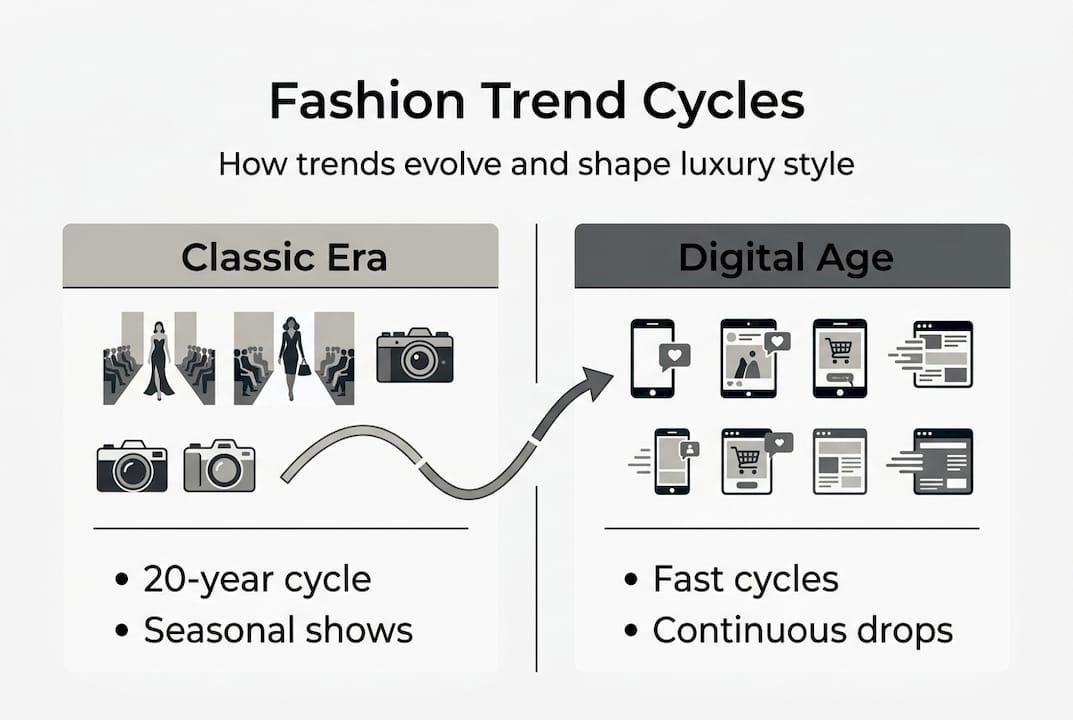
The 20-year cycle has not disappeared, but digital platforms have layered something new on top of it: speed. Digital platforms and social media now compress traditional trend durations from 12 to 24 months down to weeks, enabling rapid adoption through influencers and real-time content.
The traditional fashion calendar once gave consumers a clear rhythm. Collections were shown months before they hit stores, giving editors and buyers time to filter what reached the public. That buffer is largely gone now.
| Traditional fashion cycle | Digital-era fashion cycle |
|---|---|
| 2 major seasons per year | Continuous drops and micro-seasons |
| Trends last 12 to 24 months | Trends can peak and fade in 8 to 12 weeks |
| Gatekeepers: editors and buyers | Gatekeepers: algorithms and influencers |
| Consumer sees trend months after runway | Consumer sees trend in real time |
| ‘See now, buy later’ model | ‘See now, buy now’ model |
For luxury consumers, this creates a specific challenge. The volume of visual content is enormous, and the pressure to stay current can feel relentless. But the brands that command the highest loyalty and resale value are rarely the ones chasing every digital trend. They are the ones that use digital platforms strategically while maintaining a clear aesthetic identity.
Understanding the role of influencer marketing impacts helps clarify this. Influencers can introduce a luxury piece to a massive audience overnight, but the pieces that retain cultural value are those tied to a house’s heritage, not just a viral moment.
The most sophisticated luxury buyers use digital media as a research tool, not a shopping trigger. They watch what surfaces on platforms, cross-reference it with historical trend data, and make deliberate decisions rather than reactive ones.
- Follow a small number of trusted style voices rather than broad trend aggregators
- Use platform saves and bookmarks to track what you return to repeatedly, not just what catches your eye once
- Give yourself a waiting period before purchasing anything that feels trend-driven
Luxury’s new focus: Prestige over mass trends
The economic democratization of fashion through ready-to-wear and fast fashion multiplied available styles dramatically. Haute couture no longer dictates a single dominant look. Luxury’s response has been to double down on what mass fashion cannot replicate: exclusivity, heritage, and signature accessories.
Accessories have become the primary language of luxury distinction. A bag, a pair of sunglasses, or a piece of jewelry communicates brand identity and personal taste without requiring a head-to-toe designer look. This shift is strategic. Accessories are more accessible price-wise than full looks, they transcend seasonal silhouettes, and they carry the highest brand recognition.
Here is how to build a prestige-focused wardrobe in a fragmented trend landscape:
- Identify your signature pieces. Choose two or three items that represent your aesthetic at its clearest. These anchor everything else.
- Invest in accessories with heritage. Pieces tied to a house’s long-term identity hold value better than trend-specific designs.
- Limit seasonal additions. Instead of refreshing your wardrobe every season, add one or two considered pieces per year.
- Prioritize craftsmanship over novelty. Ask whether a piece will still feel intentional in five years, not just five months.
- Research resale value. Luxury items with strong secondary market performance signal genuine prestige, not just marketing.
Pro Tip: The accessories category is where luxury styling tips consistently show the highest return on investment, both financially and aesthetically. One well-chosen bag or pair of sunglasses can elevate an entire wardrobe without requiring constant updates.
The brands leading luxury fashion innovation are not simply reacting to trend cycles. They are creating their own gravitational pull, making consumers orbit around a house identity rather than a seasonal moment.
A fresh perspective on following luxury trends
Here is something the trend industry rarely says out loud: chasing trends is the opposite of luxury. Real luxury has always been about selective adoption, not comprehensive coverage. The most stylish people in any room are rarely wearing the most current thing. They are wearing the right thing for them, worn with complete conviction.
The State of Fashion report highlights a telling detail: jewelry outperforms most other luxury categories even during market contractions. That is not because jewelry is trendy. It is because jewelry is personal, durable, and identity-defining in a way that seasonal clothing rarely is.
This points to a broader truth. Your wardrobe should function as a personal archive, not a trend log. Every piece you own should tell something true about who you are, not just when you bought it. The 20-year cycle and digital acceleration are useful frameworks for understanding the market, but they should inform your decisions, not drive them.
We believe the most powerful move a luxury consumer can make right now is to define their own trend arc. Explore the conscious fashion guide to understand how intentional curation creates a wardrobe that outlasts any microtrend. The goal is not to be ahead of the trend. It is to be beyond it.
Curate your luxury style with MaraFormigone
Understanding why trends evolve is only valuable if it changes how you shop. At MaraFormigone, we curate pieces that are built to outlast the cycle, not just participate in it. Our selection focuses on accessories and signature items from houses with genuine heritage, giving you the foundation for a wardrobe that holds its identity across seasons.
If you are ready to invest in pieces that carry real prestige, start with the details. The Love Moschino shoulder bags in our collection offer bold house identity in a format that works across every season. For eyewear that signals considered taste, the Smooder Sunglasses deliver exactly the kind of signature accessory that defines a personal style arc rather than chasing one.
Frequently asked questions
What is the main reason fashion trends evolve over time?
Fashion trends evolve because of a constant push and pull between social conformity and individual differentiation, which creates cyclical patterns roughly every 20 years. Cultural, economic, and technological shifts layer on top of this dynamic to shape each era’s specific aesthetic.
How has social media changed the evolution of fashion trends?
Social media platforms compress traditional 12 to 24-month trend durations down to weeks, enabling rapid adoption through influencers and real-time content. This means luxury consumers now need stronger editorial filters to avoid being swept up in short-lived microtrends.
Why do old luxury trends come back into style?
Old trends resurface because of generational cycles: what feels dated to one generation reads as fresh to the next. Empirical analysis of 37,000+ images confirms this roughly 20-year rhythm, though post-1980 fragmentation means revivals now compete with many simultaneous aesthetics.
How do luxury brands set themselves apart in a world of fast fashion?
Luxury brands focus on exclusivity, craftsmanship, and signature accessories rather than chasing every microtrend. Economic democratization of fashion has pushed prestige houses to double down on heritage identity as their primary point of distinction.
Recommended
- What is luxury fashion: Understanding high-end style in 2026 – MaraFormigone
- Fashion seasons explained: master luxury in 2026 – MaraFormigone
- High-end fashion styling tips for luxury looks in 2026
- How innovation drives luxury fashion success in 2026 – MaraFormigone
- Luxury Fashion Trends: How They Shape Modern Style

