
Sometimes, the most powerful authentication tools you have are your own senses. A quick check of a bag's weight, its scent, and the feel of the hardware can often expose a counterfeit in seconds. Fakes almost always cut corners with cheap materials, and the results are obvious: they feel too light, smell of chemicals, and have flimsy, poorly finished hardware.
Your First Look Authentication Checklist
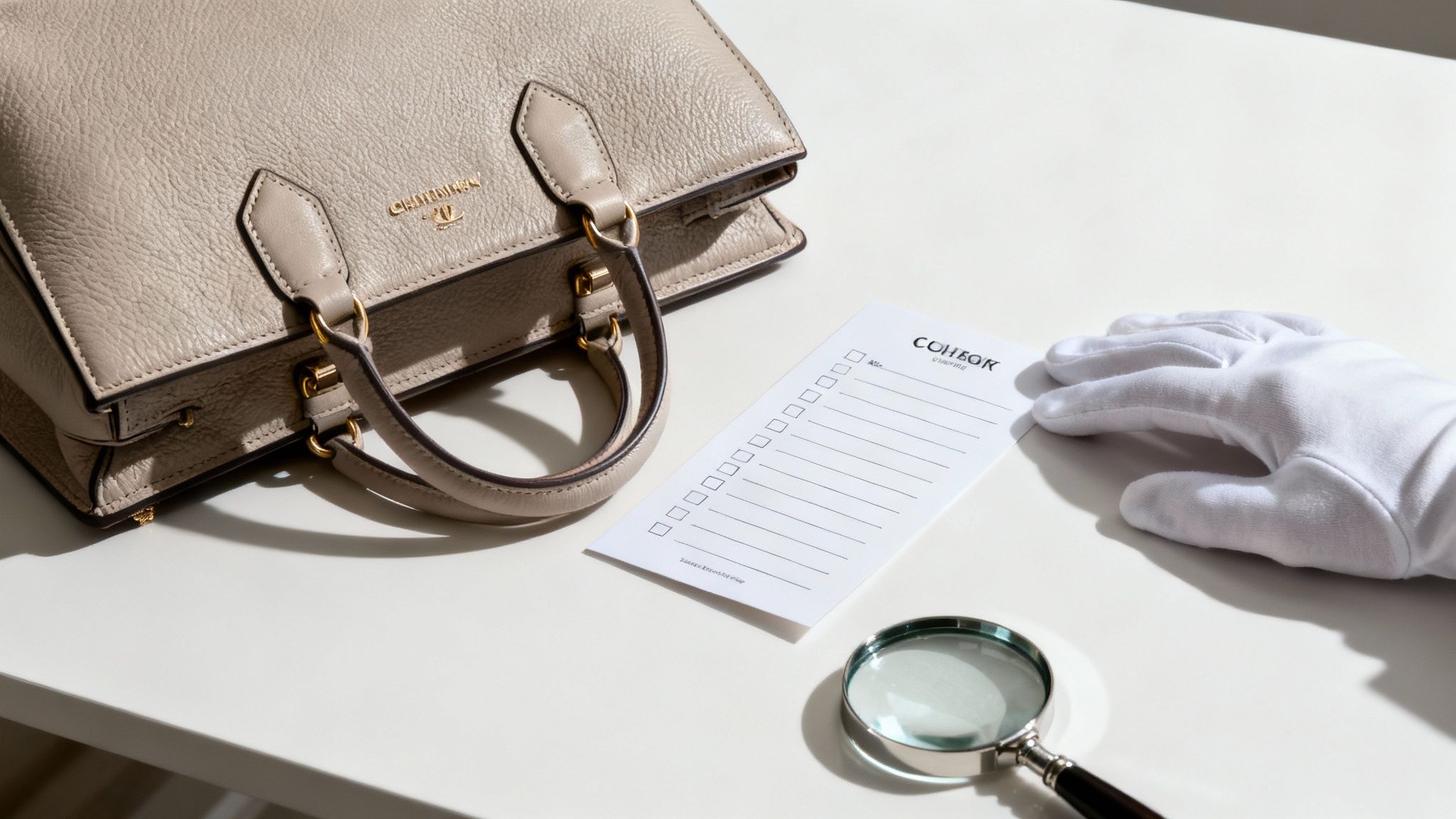
Before you get out a magnifying glass to inspect stitching and serial numbers, a simple five-minute once-over can weed out the most blatant fakes. Think of it as a first-pass filter for a potential purchase.
Your first impression is incredibly valuable. Counterfeiters bet on flashy logos and familiar shapes to distract you from the fundamentals they got wrong.
Trust Your Initial Instincts
Your sense of touch and smell are your best allies right from the start. A genuine luxury bag is a serious investment in craftsmanship and high-end materials, and it should feel that way—substantial and well-constructed. Counterfeits, on the other hand, often feel disappointingly light because they’re made with cheap, hollow hardware and inferior synthetic leathers.
The smell is another dead giveaway. Real leather has a distinct, rich, and earthy scent. Many fakes are made from PU leather or treated with harsh chemicals, leaving them with an overpowering plastic or chemical odour you just can't miss. If it smells more like a factory than a luxury boutique, that’s a huge red flag. This idea of using your senses isn't unique to handbags; you'll find similar principles in this expert guidance on how to spot fake antiques, where initial sensory checks are just as critical.
Key Takeaway: Never dismiss your gut feeling. If a bag feels too light, looks unnaturally shiny, or smells of chemicals, treat it with extreme suspicion, no matter how good the logo might look from a distance.
Quick Authentication Authentic vs Counterfeit
To make this initial check even easier, I've put together a quick comparison table. It breaks down what you should expect from an authentic bag versus the common red flags you'll see on a fake.
Think of this as a mental checklist you can run through anytime you're considering a pre-owned bag. The same core principles apply whether you're looking at a Chanel flap or learning how to authenticate a Tory Burch bag, where the quality of the materials and hardware are always the first things to check.
| Attribute | Authentic Designer Bag (What to Look For) | Common Counterfeit Bag (Red Flags) |
|---|---|---|
| Overall Weight | Feels substantial and well-balanced, reflecting quality materials. | Surprisingly light or unevenly weighted due to cheap hardware. |
| Initial Smell | A rich, natural leather scent or a neutral smell for treated fabrics. | A strong chemical, plastic, or glue-like odor that is overpowering. |
| Hardware Glance | Has a quality finish (not too shiny), feels solid, and is well-engraved. | Looks cheap, overly shiny, or plasticky; may be lightweight or hollow. |
| Structure & Shape | Stands on its own (if designed to) with perfect symmetry and form. | Slouches, appears misshapen, or has asymmetrical handles or panels. |
Running through these quick points can save you a lot of time and help you immediately dismiss the low-quality fakes, letting you focus your attention on the more convincing ones.
Feel the Difference: A Hands-On Guide to Materials and Craftsmanship
While a quick glance can catch the most obvious fakes, the real story of a luxury bag is told through its materials and the way it’s put together. Think of a genuine bag as an investment in artistry. Counterfeiters can copy a shape, but they almost always fail to replicate the soul of a bag—its feel, its structure, and its flawless execution.
This is where you need to trust your hands and eyes. The difference between real, high-quality leather and cheap synthetics is night and day. Learning how to spot fake designer bags often starts by simply touching the material.
Evaluating Leather and Materials
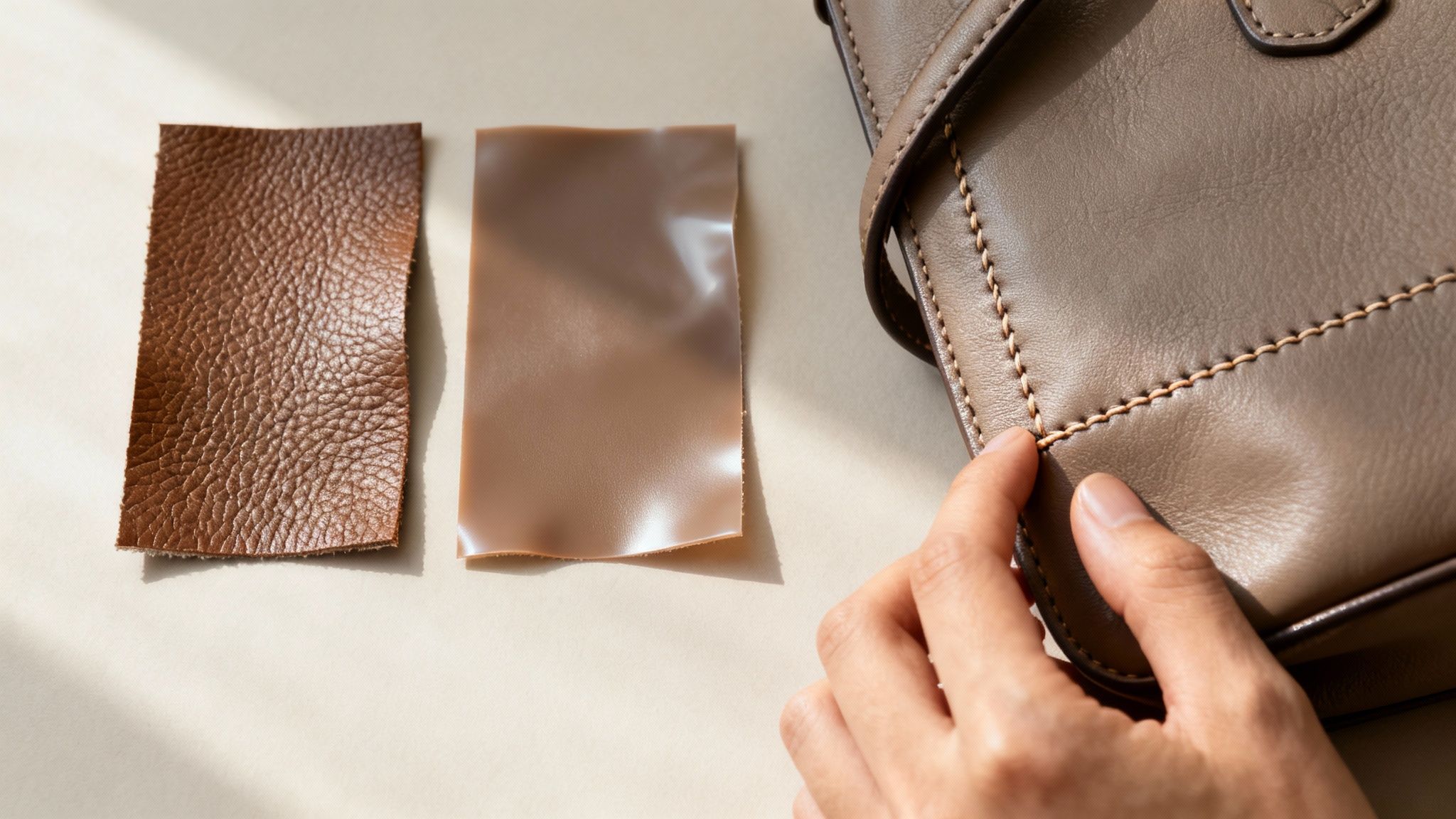
Authentic designer bags almost always use premium leathers like full-grain, lambskin, or calfskin. These materials feel supple and rich, and they have a unique texture with subtle, natural imperfections. They feel alive in your hands and develop a beautiful patina over time.
In contrast, counterfeit bags typically use coated synthetic materials, often called "pleather." These fakes tend to feel stiff, unnaturally smooth, or even a bit sticky. They might also have a plastic-like sheen under light that just looks cheap. For specific textures like Prada's iconic cross-hatch pattern, you can learn more about what is Saffiano leather in our detailed guide to understand its unique feel and durability.
Pro Tip: Gently bend a small, inconspicuous part of the bag, like a corner flap. Real leather will wrinkle naturally under pressure, much like skin. Fake leather often resists, feels rigid, or creates sharp, unnatural-looking creases.
The quality of the materials is one of the biggest giveaways. Authentication services consistently find that the vast majority of fakes use subpar materials that fall apart. This problem is widespread; the counterfeit market is a massive industry, with some estimates suggesting that as much as 10% of designer bags in circulation could be fakes.
Scrutinizing the Art of Stitching
Once you've felt the material, shift your focus to the stitching. This is a direct reflection of a brand's standards. On an authentic bag, the stitching is a work of art in itself.
Look closely at the seams. The stitches should be perfectly even, with consistent spacing and thickness. Many high-end brands, like Hermès, use a subtle, slanted saddle stitch that is incredibly difficult for machines to replicate perfectly. You should see no loose threads, no double-stitching where it doesn't belong, and no messy back-stitching used to tie off the ends. Every single thread is placed with intention.
Common stitching flaws on fake bags include:
- Uneven Spacing: Stitches that are sometimes close together and sometimes far apart.
- Thin, Flimsy Thread: Counterfeiters use lower-quality thread that can look weak or too shiny.
- Sloppy Endpoints: Messy knots or back-stitching at the start or end of a seam.
- Perfectly Straight Machine Stitches: While some brands use machines, the stitching on fakes often looks too perfect and mechanical, lacking the subtle character of luxury craftsmanship.
Assessing Structure and Symmetry
Finally, step back and look at the bag's overall structure and shape. A genuine designer bag is engineered to hold its form. If it’s designed as a structured tote, it should stand proudly on its own without slouching or collapsing. The lines should be clean, the corners crisp, and the entire silhouette perfectly symmetrical.
Set the bag on a flat surface and look at it from every angle—front, back, and sides.
- Symmetry: Are the handles perfectly aligned? Are they the exact same size and shape?
- Proportions: Does the bag look balanced? Counterfeits often have slightly "off" proportions, with panels or pockets that are too large, too small, or incorrectly placed.
- Structure: A fake bag will often sag where it should be firm. For instance, the handles might feel flimsy or the base might bow under its own weight.
This level of detailed inspection moves beyond just glancing at a logo. It’s about understanding the core principles of quality that define a luxury item. By mastering how to evaluate materials, stitching, and structure, you empower yourself to spot the subtle yet critical differences that separate a true masterpiece from a cheap imitation.
Decoding Hardware Logos and Brand Stamps
After getting a feel for the leather and inspecting the seams, it's time to zero in on the details that really broadcast a brand's identity: the hardware and logos. Counterfeiters might get close on the overall shape of a bag, but replicating the precise look, feel, and function of custom hardware is where their efforts often fall apart. Think of this step as a forensic examination—these tiny details tell a huge story.
Think of the hardware—zippers, clasps, feet, and rings—as the bag’s jewellery. On an authentic piece, it feels like it. It should be heavy, solid, and substantial in your hand. Cheap knockoffs almost always use lightweight, hollow, or plastic-coated metals that feel flimsy and just plain wrong by comparison.
The Weight and Finish of Hardware
The first test is simple: feel the weight. Pick up the bag and pay close attention to the heft of a chain strap or the pull of the main zipper. Authentic hardware is made from solid metal and has a satisfying weightiness you can't fake.
Next, get a good look at the finish. Luxury brands use high-quality plating that is smooth, consistent, and built to last. You should never see any signs of chipping, flaking, or tarnishing on a new bag. Fakes often use a cheaper plating process that results in a finish that looks too shiny—almost like plastic—or has an uneven, bubbly texture.
Real-World Example: On a genuine Chanel Classic Flap, the chain strap has a noticeable weight and moves fluidly, without kinking or catching. A fake will often have a suspiciously light chain that feels cheap and makes a tinny, hollow sound. The gold plating should be a rich, subtle hue, not a brassy, bright yellow.
This careful inspection is one of the most reliable ways to spot a fake designer bag. The quality is simply too expensive and difficult for counterfeiters to replicate perfectly.
Zippers: The Unsung Heroes of Authentication
A zipper might seem like a minor detail, but for an authenticator, it’s a goldmine of information. Many of the top designer houses don't actually produce their own zippers; they source them from reputable, high-end manufacturers.
Look for small branding marks on the zipper pull or the slider itself. Here are some of the most common ones you'll see:
- YKK: A very common, high-quality zipper manufacturer used by countless brands, including Louis Vuitton and Tory Burch. The engraving should always be clean and sharp.
- Lampo: An Italian brand known for its buttery-smooth zippers, often found on high-end bags from brands like Gucci.
- RiRi: A Swiss manufacturer famous for its incredibly smooth and polished zippers, another favourite of luxury designers.
A zipper on a genuine bag should glide effortlessly and silently. If it catches, snags, or feels gritty when you pull it, that’s a huge red flag. The pull itself should also match the quality of all the other hardware in terms of its weight and finish.
Analyzing Logos and Brand Stamps
Just as important as the hardware is the brand's logo, which is usually heat-stamped directly into the leather or engraved on a metal plaque. This is another area where fakes consistently fail to achieve perfection. A genuine stamp is a mark of absolute precision.
An authentic brand stamp should be:
- Crisp and Clear: The letters should be perfectly legible with clean edges. You shouldn't see any blurriness or bleeding of the colour into the surrounding leather.
- Evenly Pressed: The stamp should have a consistent depth across all the letters. Fakes often have stamps that are pressed too deep, looking "branded" into the material, or are so shallow they look like they’re just printed on the surface.
- Correct Font and Spacing: This is absolutely crucial. Every brand uses a specific, proprietary font. Counterfeiters often use one that's close but not quite right. Pay close attention to the shape of letters like the "O" (is it perfectly round or slightly oval?), the serifs on the "N," or the unique curve of the "G" in Gucci. The spacing between letters, known as kerning, must be perfectly even.
For example, on a Céline bag, the accent over the "E" should be sharp and distinct. On a Louis Vuitton heat stamp, the "O"s are characteristically very round, and the letters "TT" in "VUITTON" should be so close they are almost touching. These are the tiny details that counterfeiters frequently get wrong. Studying photos of guaranteed authentic stamps online before you even think about buying is an invaluable habit to get into.
Decoding Serial Numbers and Date Codes
Once you've felt the leather and checked the hardware, it's time to dig deeper. The most damning evidence against a fake is often tucked away inside the bag, disguised as a simple string of letters and numbers. These are the serial numbers and date codes, and for a savvy buyer, they’re a roadmap to a bag’s history.
These codes aren’t just random. They’re a brand’s internal language, telling a story about where and when an item was born. Learning to speak that language is one of the fastest ways to unmask even a so-called “superfake.”
The Logic Behind the Codes
Think of a date code or serial number as a bag's passport—it verifies its origin and identity. Each luxury house has a unique system, and knowing the basics is crucial.
Louis Vuitton, for example, uses a "date code" with two letters and four numbers to pinpoint the factory and production timeline. A code like "FL1230" tells you the bag was made in France (FL) during the 13th week of 2020.
Chanel, on the other hand, uses a "serial number" on a sticker, which corresponds to an authenticity card. The number of digits immediately tells you the production era. A seven-digit code, for instance, places the bag between the mid-1980s and mid-2000s, while newer bags have eight or more. Fakers often get this wrong, inventing codes that don't match the brand's established format.
The decision tree below helps visualize how these internal codes work in tandem with other physical checks, like the quality of the hardware and engravings.
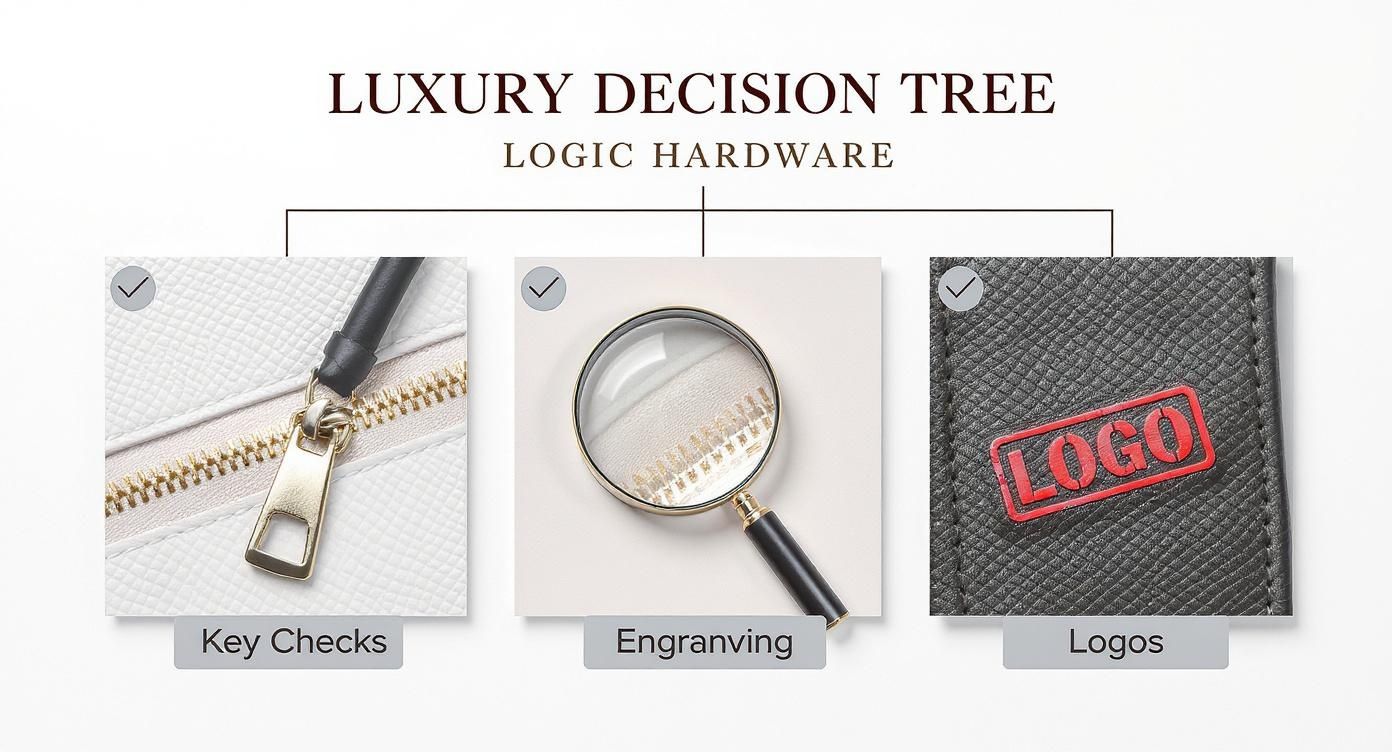
As the graphic shows, details like the zipper brand and logo font must be period-correct for the date code. If they don't match up, the bag fails the test.
Cross-Referencing Codes with Bag Styles
This is where you put on your detective hat. A serial number has to do more than just look correct—it needs to make sense for the bag it's attached to. This is a common tripwire for counterfeiters, who often mix and match popular styles with random, out-of-date codes.
Let's say you're eyeing a Louis Vuitton Pochette Métis in the sought-after Reverse Monogram canvas, a style that first hit the market in 2016. If you flip the tag and see the date code "SP0054," you have a problem. That code indicates the bag was made in France during the 5th week of 2004—a full 12 years before this specific design even existed. That’s an instant giveaway. You’re holding a fake.
Pro Tip: Do a quick Google search for the release date of the bag style you're inspecting. If the date code says the bag was made before the style was ever released, walk away. It's a counterfeit, no question.
This simple logic check is one of the most reliable tools in your arsenal. It’s a method professional authenticators swear by because it’s based on hard facts that counterfeiters frequently botch.
Fonts, Placement, and Other Telltale Signs
Beyond the numbers themselves, the way the code is presented is just as critical. The top luxury houses are obsessive about the tiny details.
- Font and Spacing: The typeface on a date code tab or serial sticker is often proprietary. Fakes frequently use a generic font that’s a little too thick, too thin, or has awkward spacing. On a Gucci tag, the heat-stamped numbers should have a specific, clean, slightly serifed font. Anything else is a red flag.
- Placement: Is the code located where it should be? A Chanel serial sticker has a designated spot depending on the model and year—often hidden deep in a corner or on a small leather tab inside a pocket. Counterfeiters might just stick it somewhere convenient, or use a flimsy sticker that peels right off.
- Application Method: How was the code applied? Louis Vuitton date codes are typically heat-stamped directly onto a leather tab. Fakes may feature poorly printed codes that look cheap or are stamped at a sloppy angle.
These are the subtle tells that separate the real deal from the knockoffs. In fact, authentication platform Entrupy found that issues with these codes were a factor in flagging roughly 33% of Louis Vuitton bags they scanned in the U.S. You can read the full report on counterfeit trends to get a sense of just how widespread these errors are. Paying attention to these details is what separates an informed buyer from a potential victim.
Smart Buying Strategies to Avoid Counterfeits
Being able to spot a fake in person is a fantastic skill, but honestly, the best way to avoid getting duped is to be a savvy shopper from the very beginning. Your best defense starts long before the bag is even in your hands. It's all about understanding who you're buying from, what to look for in the listing, and recognizing the red flags that scream "fake."
If a deal looks too good to be true, it is. That's the golden rule of luxury shopping, and it has never failed me. Authentic designer bags hold their value for a reason—they are investments built on incredible craftsmanship and timeless appeal. You simply won't find a legitimate, brand-new bag that retails for thousands of dollars on sale for a few hundred. An unbelievable discount is the number one sign you’re looking at a counterfeit.
Price is the First and Loudest Red Flag
More often than not, the price tag tells you everything you need to know. High-end bags have high-end prices because they're made with premium materials by skilled artisans, backed by the legacy of a renowned fashion house. The counterfeit industry is a massive global problem, and it preys on our desire for that luxury look without the luxury price tag.
The global market for counterfeit goods is now worth an estimated $464 billion—a staggering figure that rivals the GDP of some countries. And it's only gotten worse with the rise of social media, where sponsored posts can easily push fakes on unsuspecting shoppers. When you see that jaw-dropping discount, just remember the illicit industry it's likely coming from.
How to Properly Vet Online Sellers
In the wild west of online marketplaces, the seller is every bit as important as the bag itself. Whether you’re on a huge platform or a small, niche forum, doing your homework on the seller is non-negotiable.
Start by digging into their profile. I always look for a long history of sales with tons of positive feedback, specifically for designer goods. A brand-new account with zero track record that just happens to be selling a Birkin? That's a major red flag.
Next, take a good look at their other listings.
- Consistency is key: Does the seller seem to specialize in luxury items, or is it a random jumble of stuff? Reputable resellers usually have a focused, curated collection.
- Check their inventory: Are they selling multiples of the same "brand new" It-bag? This is a classic sign of a counterfeit operation that buys fakes in bulk.
- Examine the photography: Are the photos crisp, well-lit, and unique? A serious seller takes their own detailed pictures from every conceivable angle. Be extremely wary of blurry photos, stock images, or pictures clearly lifted from the brand's official website.
Pro Tip: Always run a reverse-image search on the product photos. If you see the same pictures pop up on other sites, especially on wholesale counterfeit platforms, you’ve just caught a scammer in the act.
The Importance of Provenance and Paperwork
Provenance—the item's history—is a huge piece of the puzzle. It adds a critical layer of security to your purchase. Now, receipts and authenticity cards can be faked, but their presence and quality are important clues when you’re assessing the whole picture.
Don't be shy about asking the seller if they have any of the original documentation.
- The Original Receipt: This is your best piece of evidence. Check that the store name, date, and item description on the receipt all line up with the bag you're looking at.
- Authenticity Card: For brands like Chanel, the serial number on the card absolutely must match the hologram sticker inside the bag. Feel the card itself—it should be substantial, with crisp, perfect printing.
- Dust Bag and Box: Just like the handbag, the packaging should be high-quality. Check the logo printing, the feel of the material, and the stitching on the dust bag.
Now, the absence of these items isn't always a dealbreaker, especially with vintage finds that have been around for a while. But a seller who can provide them and is transparent about the bag's history is always a much safer bet. For a deeper dive, you can explore our comprehensive luxury fashion shopping tips.
At the end of the day, protecting yourself means looking at everything together. And if you do end up identifying a fake, knowing how to report counterfeit products can help prevent others from falling into the same trap. By combining a sharp eye with smart shopping habits, you can navigate the pre-owned market with total confidence.
Your Top Authentication Questions, Answered
Even after you've run through a full inspection, some nagging questions can pop up. Let's be honest, spotting fakes can be tricky, and it's completely normal to feel a little unsure at first. I've heard these same questions time and again, so let's clear up some of the most common points of confusion.
Think of this as the final gut-check before you make a decision.
"It Came with an Authenticity Card and Receipt, So It's Real, Right?"
This is probably the biggest and most dangerous assumption people make. The short answer? No, not necessarily. Think about it: if counterfeiters can go to the trouble of faking an entire handbag, printing a convincing piece of plastic or a paper receipt is child's play for them.
High-quality fakes, often called "superfakes," almost always come with a full set of counterfeit paperwork. It's all part of the illusion.
My Advice: Treat paperwork as a minor, supporting detail—never the main event. A genuine vintage bag might have lost its papers long ago, while a brand-new fake will have pristine ones. Your focus should always, always be on the bag itself: the materials, the hardware, the soul of the piece.
"I Thought All Designer Bags Were Made in Italy or France. This One Says 'Made in China'..."
This is a classic misconception, but the luxury world has changed. While heritage powerhouses like Chanel and Hermès maintain their European production, many other top-tier brands have globalised their manufacturing to keep up with demand.
You might be surprised to learn which brands produce items outside of Europe:
- Prada has been known to manufacture certain product lines in various locations.
- Coach has a long-established history of production in different countries.
- Tory Burch and many other contemporary brands work with manufacturing partners all over the world.
The trick is to do your homework on the specific brand and style you're looking at. A "Made in China" tag is a dead giveaway on a Louis Vuitton, but it could be perfectly correct for a bag from another respected designer. It all comes down to knowing what's normal for that particular brand.
"Is It Really Worth Paying for a Professional Authenticator?"
Without a doubt, yes. Developing your own eye for detail is a fantastic skill, but there are times when you absolutely need to call in an expert. If you're about to drop a serious amount of money on a bag, or if you're looking at a superfake that seems just a little too perfect, a professional authentication service is your best insurance policy.
These authenticators have seen and handled thousands of bags. They have access to massive databases and a trained intuition that you just can't get from reading articles online. For what is usually a small fraction of the bag’s cost, you get a definitive answer and, more importantly, total peace of mind. It’s a small price to pay to know your investment is real.
Ready to invest in luxury without the worry? At Mara Formigone, every piece is guaranteed 100% authentic, sourced directly from authorized suppliers. Shop our curated collection of new designer bags with complete peace of mind.